In Northern Liberties, Your Real Competition Might Be the Landlord
October 8, 2026
October 8, 2026
A Northern Liberties condo owner decided to sell his first-floor two-bedroom and listed it on Facebook Marketplace. He did it on purpose. According to an April 2026 Philadelphia Inquirer "How I Bought This House" profile, he skipped an agent because he didn't want the company that owned a big chunk of the complex to snap the unit up. He wanted to sell to someone who would live there.
The buyer, Katie Pratt, found the listing. The 614-square-foot unit was listed at $175,500. She offered $160,000, which she described as a common price for units in that complex, and the two sides settled at $165,000. Then the inspection turned up old windows and electrical issues in the kitchen, and she tried to bring the price back to $160,000. By then the management company had heard about the sale and offered the seller $165,000 in cash. "If that hadn't happened, I could have probably negotiated to $160,000," she told the Inquirer.
That $5,000 is the Northern Liberties market in miniature. An institutional owner can step in with cash, match an agreed price, and quietly take away the leverage an inspection normally gives a buyer. That price point sits below where most of our clients shop. The mechanism holds at every price point, because the same kind of owner shapes much of the neighborhood.
Inspection findings give a buyer leverage when the seller's next-best option is weaker than the deal on the table. A seller facing a renegotiation usually has to weigh relisting, waiting, and starting over. In the Pratt purchase, the seller's fallback was a cash buyer already inside the complex, offering the same $165,000 with no financing to clear. Her inspection report described real problems. It just stopped being worth a price cut.
The story doesn't name the complex or the management company, so it shouldn't be read as a rule for any particular building. It does point to a question buyers in this neighborhood rarely think to ask early. Who else already owns units here, and do they buy?
The largest owner in the neighborhood's core is easy to name. The Post Brothers have built and acquired a sprawling Northern Liberties portfolio over the past eight years, the Inquirer reported in July 2026. It includes the Piazza at 1001 N. Second St., which Bart Blatstein built in 2009 and which defined an earlier era of the neighborhood, plus townhouses and larger two- and three-bedroom apartments.
| Project | Address | Units | Status |
|---|---|---|---|
| The Piazza | 1001 N. Second St. | Original Blatstein project | Built 2009, acquired by Post Brothers |
| Piazza Alta, phase one | 1099 Germantown Ave. | 695 | Completed 2023, 98% leased per July 2026 reporting |
| Piazza Alta, phase two | Germantown Ave. site | 431 | Under construction, completion targeted for 2027 |
| The Mercato | 1021 Hancock St. | 241 studios and one-bedrooms | Construction expected to start Q4 2026, about two years to finish |
The Mercato shows where this pipeline is aimed. Earlier plans for the Hancock Street site called for a 13-story, 280-unit building with furnished apartments and commercial space. The current plan is six stories. CEO Michael Pestronk told the Inquirer the company "reconceptualized it for today's market," so that it "becomes the more affordable entry point at the Piazza."
For a buyer, this means the neighborhood's newest housing will be priced to compete for exactly the person who is weighing a first condo purchase. A 241-unit building of studios and one-bedrooms marketed as an entry point gives a would-be condo buyer a fresh rental option next door to the units they are touring.
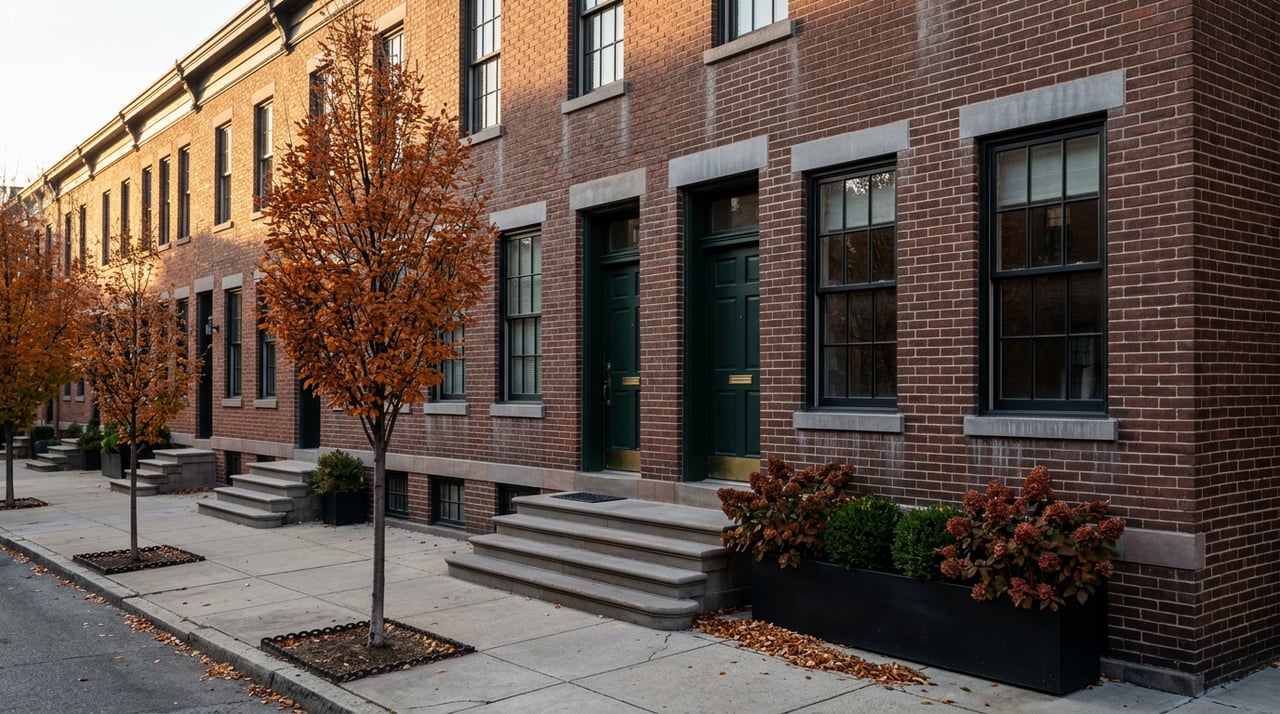
The Northern Liberties Neighborhood Association praised the Mercato's brick materials. Its zoning committee also wrote in May that "the main loss from the neighbors' perspective is the activated street edge that was present previously," because the new plan drops ground-floor commercial space. Pestronk said the narrow surrounding streets make retail and loading impractical there. The project went to the advisory-only Civic Design Review on August 4, 2026. We could not confirm the outcome of that review.
Every condo or townhouse here gets measured against what renting nearby would cost, so the strength of the rental market feeds straight into what owners can ask. On that question, 2026 sources point in somewhat different directions.
"What we're seeing in core Northern Liberties is what you're seeing across the better properties in the market, like the Rittenhouse area, that are basically fully recovered." Michael Pestronk, Post Brothers, July 2026
The same Inquirer article notes that Northern Liberties and Fishtown had recently been dealing with a glut of apartments competing for tenants. Pestronk says that condition has eased in the neighborhood's core. On August 25, 2026, CoStar ran a story headlined around apartment concessions easing from winter highs, with the subhead "Renters can still find lease specials in Northern Liberties and Fishtown." Its summary says concessions across Philadelphia remain well above historical levels, even as landlords in the most in-demand neighborhoods start to pull them back.
These accounts can both be true. The best-located buildings near the Piazza may be close to full while lease specials still circulate a few blocks away. Supply explains why the specials haven't disappeared. The Center City District's 2026 housing report, released September 14, found that ZIP 19123 ranked among the top three ZIP codes in the city for housing completions. It covers Northern Liberties, Poplar, and the central Delaware waterfront. Together with 19122 and 19125, it added more than 3,850 units between January 2025 and June 2026.
A steady flow of new rentals gives a would-be buyer a credible alternative to buying. That limits how far resale prices can run ahead of rents, and it keeps the institutional landlord involved in the decision even when it isn't bidding on the unit.
Northern Liberties carries a second institutional fingerprint, on the tax bill. The Inquirer's 2023 mapping of 20 years of abatement data shows the formerly industrial neighborhood saw an abatement-driven development boom first, before activity spread up into Fishtown. A Reinvestment Fund policy director pointed to Northern Liberties as one of the places where the maps capture development pressure most clearly.
That history means many homes here were built or renovated under one of two different abatement rules. A buyer needs to know which one applies.
The city's own guidance adds two details that matter during a sale. A new-construction abatement runs ten years starting the month after the title date. While it lasts, the home can't receive the Homestead exemption.
The arithmetic is simple. Philadelphia's combined real estate tax rate is 1.3998% for 2025 through 2029, so every $100,000 of assessed value that comes off abatement adds about $1,400 a year to the bill. On a high-end townhouse with a large share of its value in the improvement, the tax shown on a listing in an abatement year can be well below what the next owner will pay a few years later.
Reassessment adds another layer. Philadelphia mailed Tax Year 2027 valuation notices at the end of June 2026, and the new assessments take effect January 1, 2027. The city estimated a change of about $97 for a median-value residential property, and the Inquirer reported that citywide median assessments rose 3% from tax year 2025 to 2027. As of today, October 3, 2026, the deadline for formal appeals is October 5, 2026.
The rules may change again. In September 2026, Mayor Cherelle Parker urged Council to consider a targeted abatement of up to 20 years for converting deteriorated properties to housing. As of the Inquirer's September 24 report, no bill had been sent, and Council President Kenyatta Johnson wanted it to include an affordable-housing component.
None of this is tax advice. The point is that a listing's monthly carrying cost is a snapshot that depends on the property's abatement status.
Public market statistics at the ZIP code level for 19123 aren't readily available, so the closest current benchmark is Philadelphia County. In August 2026, Bright MLS reported a county median sold price of $290,000, up 5.5% from August 2025, with 26 median days on market. Active listings rose 11.1% year over year to 4,963, and months of supply reached 4.38. New listings were up 7.6% while new pending sales fell 6.9%.
As of August 2026, then, the county has more inventory and slightly slower contracts than a year earlier, which would normally favor buyers. In a Northern Liberties building with a large owner already inside, that advantage can vanish at the moment it matters most. The Pratt purchase shows how. The buyer had time and an inspection report on her side, and the management company's cash offer cancelled both.
Buying in Northern Liberties means pricing against the landlords as much as against other buyers. At Philly Luxe Living, Jamie Smith Raphael reviews ownership concentration, abatement timelines, and nearby rental competition for any Northern Liberties property before an offer goes in, so your leverage is planned before the inspection rather than discovered after it. Request a private consultation to review a specific building or townhouse.
Stay up to date on the latest real estate trends.


3 Best Places to Go Apple Picking Near Philadelphia & Bucks County in Fall 2026
Jamie Smith Raphael, a luxury real estate agent in the Philadelphia Area with a passion for her career and clients, brings extensive industry experience, skillfully handling transactions exceeding $150 million, always prioritizing an exceptional client experience.